Which Aquariums Currently Have Whale Sharks?
Five aquariums currently keep whale sharks: Osaka Aquarium Kaiyukan, Okinawa Churaumi, Ioworld Kagoshima, Chimelong Ocean Kingdom and Georgia Aquarium, which was left with one shark after August 2025. Anyone asking which aquariums currently have whale sharks gets the short list first, then the tank, the number of animals and the way to see each one. The page also covers which aquariums gave up their whale sharks and why, so you know what to expect before you book.
Quick answer
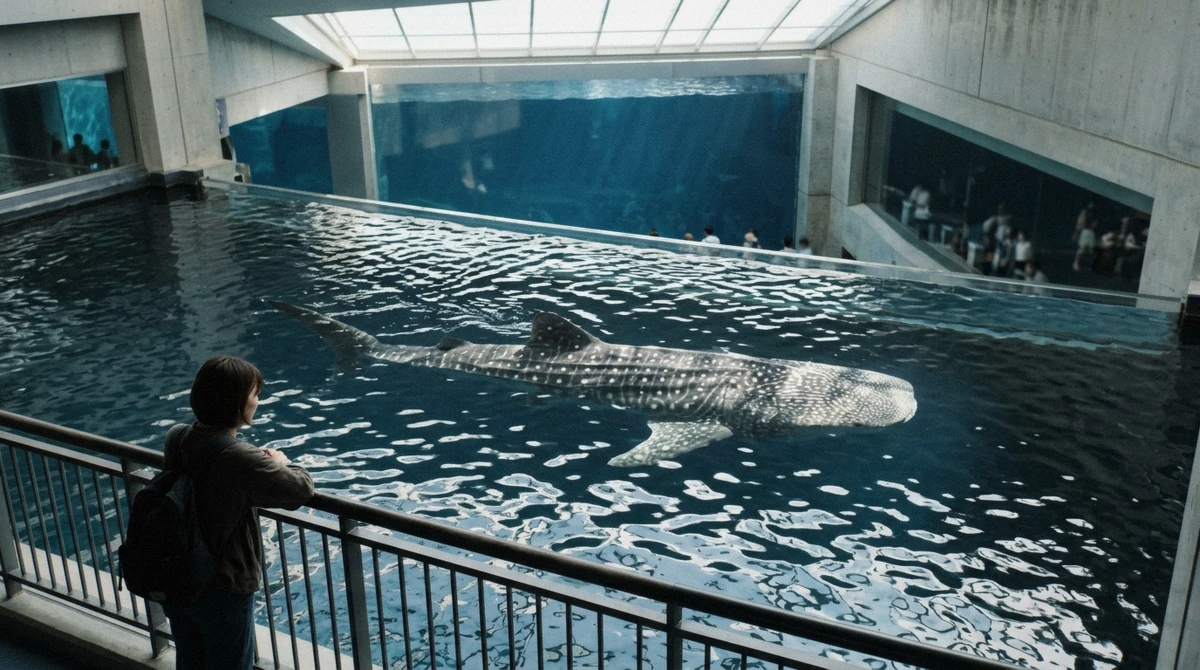
Only a handful of aquariums keep whale sharks today: Osaka Aquarium Kaiyukan (two), Okinawa Churaumi Aquarium, Ioworld Kagoshima Aquarium, Chimelong Ocean Kingdom in China and Georgia Aquarium in Atlanta, which was left with one after August 2025. Osaka is the easiest to reach from a city centre.
Key takeaways
- After Taroko died in August 2025, Georgia Aquarium was left with one whale shark, Yushan, in a 6.3 million gallon (about 23.8 million litre) tank
- Osaka Aquarium Kaiyukan shows two, Kai and Yuu, in a 5,400-ton tank that is five minutes' walk from Osakako Station
- Okinawa Churaumi has the biggest Japanese tank at 7,500 cubic metres, but Okinawa is a separate flight from the main island
- The skip-the-line aquarium ticket is the simplest way to see Kai and Yuu on a fixed date, and it comes with a digital feeding-times guide
- Georgia Aquarium is the only aquarium outside Asia that keeps whale sharks, and it sells dive and swim sessions in the same tank
See Whale Sharks Without Leaving Osaka
Of every aquarium that keeps whale sharks, Osaka is the one you can reach by metro from a hotel in 25 minutes. These two bookings put you in front of the Pacific Ocean tank.
 from $35
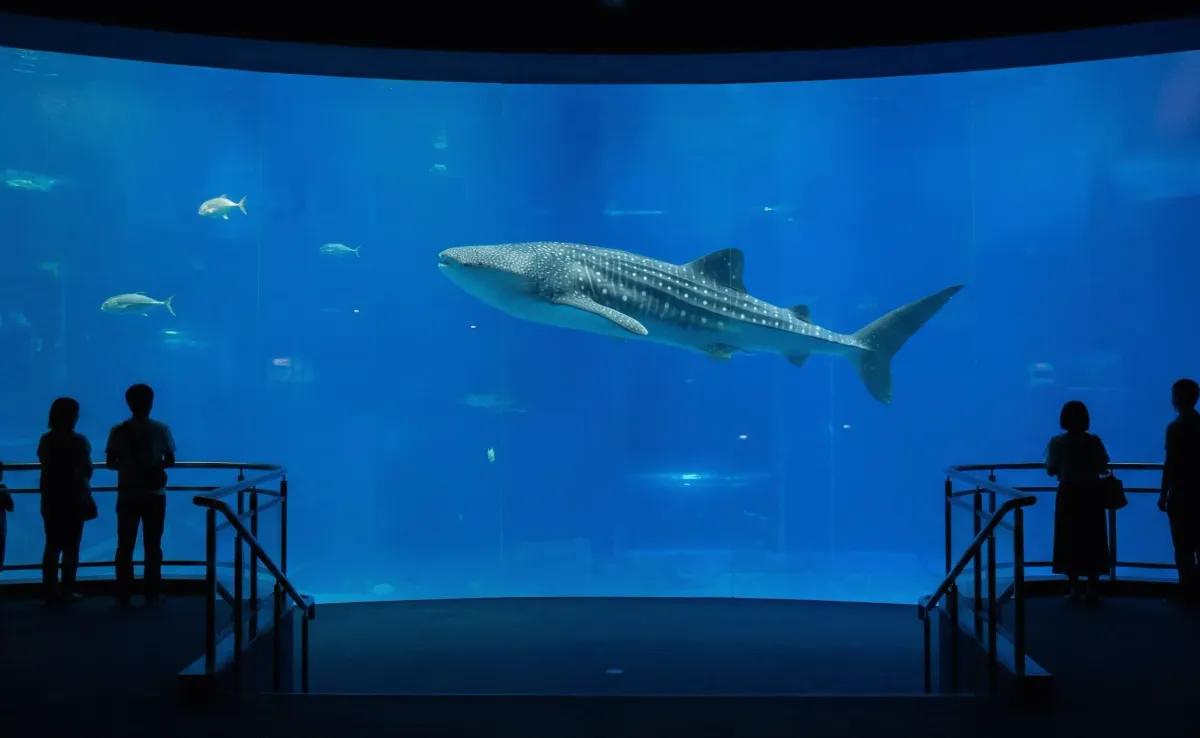
Skip the Queue: Osaka Aquarium Entry Ticket + Digital Feeding-Time Guide
Pre-booked entry to Osaka Aquarium with QR-code scan directly at the entrance — no ticket-counter queues. Includes a complimentary digital Ocean Life guide sent after booking so you…
- Skip the ticket-counter queues — scan QR code straight at the entrance
- See the whale sharks in the massive 9-metre-deep Pacific Ocean tank
- Free digital guide: animal feeding schedule + best viewing spots
- Free cancellation up to 24 hours before your visit
 from $215
Spring only
Nemophila Festival & Osaka Aquarium Day Trip
A seasonal small-group day trip that pairs the nemophila bloom at Maishima Seaside Park with an afternoon at Osaka Aquarium. A driver-guide handles the transport, so you spend…
Runs only during the nemophila bloom, roughly April to mid-May.
- Over a million blue nemophila flowers by Osaka Bay at Maishima
- Two hours at Osaka Aquarium in the afternoon
- Round-trip transport and an English or Chinese speaking driver-guide
- Small group, max 9 people, with hotel pickup included
Which Aquariums Have Whale Sharks Right Now?
Five aquariums in the world are known to keep whale sharks on display today: three in Japan, one in southern China and one in the United States. The table lists them with the tank each one uses and what a visitor can expect to see. Tank figures come from each aquarium's own pages where available.
| Aquarium | Country | Tank | Whale sharks on show |
|---|---|---|---|
| Osaka Aquarium Kaiyukan | Japan | Pacific Ocean, 9 m deep, about 34 m long, 5,400 tons (about 5.4 million litres) | Two: Kai (male) and Yuu (female) |
| Okinawa Churaumi Aquarium | Japan | Kuroshio Sea, 7,500 m3 (7.5 million litres), 10 m deep | A school of whale sharks with manta rays |
| Ioworld Kagoshima Aquarium | Japan | Kuroshio Great Water Tank, about 1,500 tonnes (1.5 million litres) | Young sharks caught locally, released at about 5.5 m |
| Chimelong Ocean Kingdom, Zhuhai | China | Whale shark aquarium inside the ocean park | On show, count not published |
| Georgia Aquarium, Atlanta | United States | Ocean Voyager, 6.3 million gallons (about 23.8 million litres) | One, Yushan, after Taroko died in August 2025 |
Three of the five are in Japan, which is why a trip there is the best way to see whale sharks in an aquarium. Counts change when an animal is moved, released or dies, so the headline number to remember is the type of arrangement: Kaiyukan keeps a pair, Churaumi keeps a group, Kagoshima keeps young ones for a limited time, and Atlanta keeps a single animal.
Source: Okinawa Churaumi Aquarium, Georgia Aquarium, Whale shark, Wikipedia.
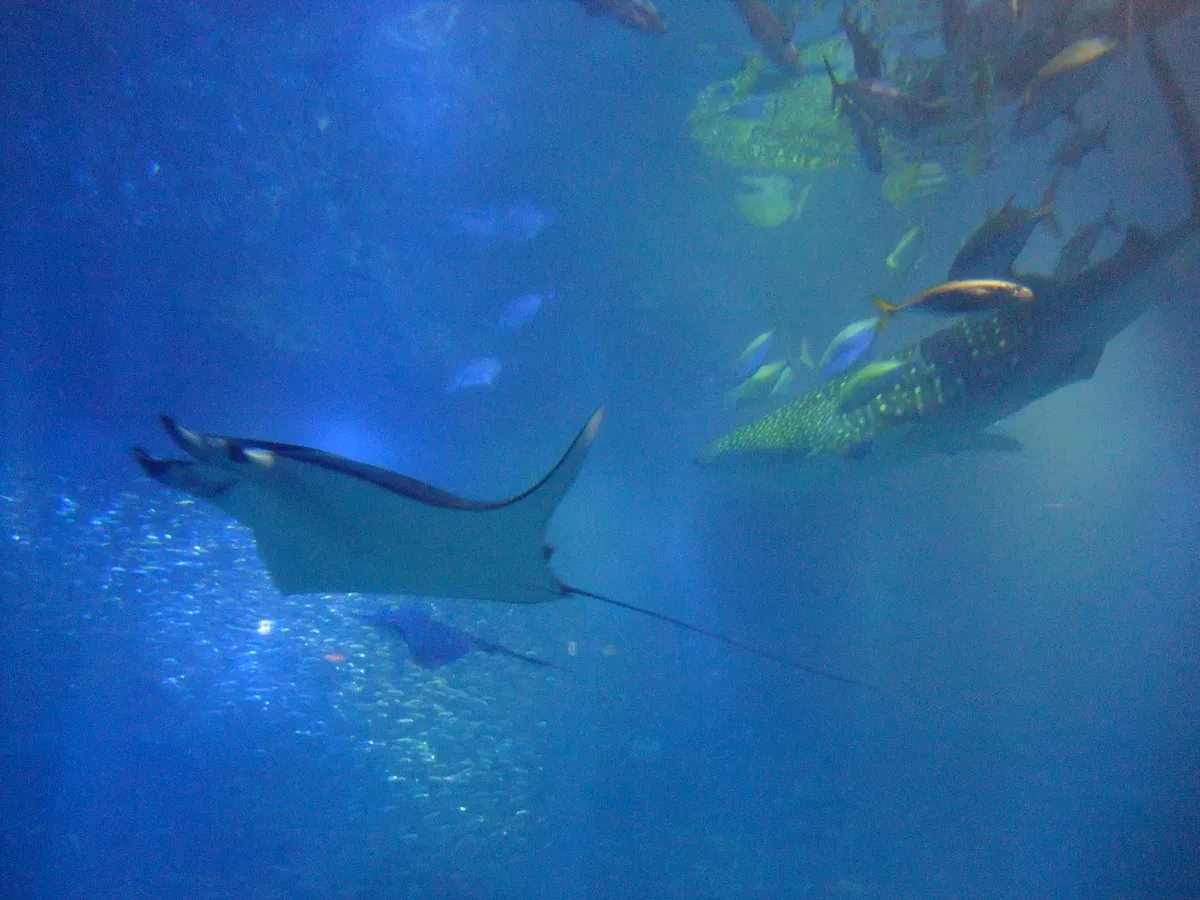
A whale shark and a manta ray in the Pacific Ocean tank at Osaka Aquarium Kaiyukan. Photo: SR EXR, CC0, via Wikimedia Commons
Does Georgia Aquarium Still Have Whale Sharks?
Yes, but only one. After his tankmate Taroko was euthanized in August 2025 when his condition declined, Georgia Aquarium in Atlanta was left with a single whale shark, a male named Yushan, according to local news reports at the time. The two had been the only whale sharks in the building since 2021, and they came from Taiwan.
Taroko first went on show on 1 June 2007.
The sharks live in Ocean Voyager, a 6.3 million gallon exhibit, which is about 23.8 million litres. Its main viewing window is 23 feet tall, 61 feet wide and 2 feet thick, which is roughly 7 by 18.6 metres and 0.6 metres of acrylic.
Georgia Aquarium is also the only aquarium outside Asia that has kept whale sharks. Earlier animals did not do as well. Ralph and Norton died in 2007, Trixie in 2020 and Alice in 2021.
For a visitor, the practical point is that an Atlanta trip no longer promises a group of sharks gliding past in formation, only one animal sharing the tank with manta rays and other fish.
Source: Georgia Aquarium Ocean Voyager, Atlanta News First, AJC.
Will Georgia Aquarium Get More Whale Sharks?
No new whale shark was announced when Taroko died. The aquarium's own whale shark page covers the Ocean Voyager exhibit and the Journey with Gentle Giants dive and swim sessions, so check it for the animals on show before you plan an Atlanta trip around a whale shark, and treat any later arrival as a bonus.
The history explains the caution. Whale sharks are hard to keep, and the first four animals Atlanta brought in from Taiwan were all gone by 2021. The species has been listed as endangered since 2016, so any new animal is a serious undertaking.
Does Osaka Aquarium Still Have Whale Sharks?
Yes, two. Osaka Aquarium Kaiyukan keeps a male called Kai and a female called Yuu in its Pacific Ocean tank, which is about 9 metres deep, 34 metres long and holds about 5,400 tons of water. The tank sits in the middle of the building, so the sharks appear at the window on several floors as you walk down the spiral route.
Kai is the newer of the pair. He arrived on 2 October 2024 from the aquarium's own research centre in Kochi, 4.7 metres long at the time, and replaced the earlier male, which was fitted with a data logger and released into the Pacific to track its route. When keepers measured him on 30 October 2026 he had grown to 5.76 metres, while Yuu measured 6.2 metres.
The aquarium names whale sharks by role, so males are Kai and females are Yuu, and the names on the sign stay the same even when the animals change. Floor-by-floor detail is in the guide to what you will see at Osaka Aquarium.
Adult admission runs from ¥2,700 to ¥3,500 (about $17 to $22) depending on the date, and the full breakdown is in the tickets guide. From Namba the metro takes about 25 minutes with one change at Honmachi, so a whale shark visit fits into a normal sightseeing day. A skip-the-line ticket with a digital feeding-times guide costs $35 and is worth it on busy weekends.
Source: Kaiyukan, Kai arrives, Kaiyukan, whale shark measurements.
Does Okinawa Churaumi Aquarium Have Whale Sharks?
Yes. Okinawa Churaumi Aquarium keeps a school of whale sharks and manta rays in its Kuroshio Sea tank, which holds 7,500 cubic metres (7.5 million litres) of water and measures 10 metres deep, 35 metres wide and 27 metres long. It is the biggest tank in Japan that holds whale sharks, and it is about 40% larger than the Pacific Ocean tank in Osaka.
It is also the original. The aquarium, then called the Okinawa Ocean Expo Aquarium, was the first in the world to keep whale sharks, starting in 1980, and it has run a long captive-care and breeding programme since. The trade-off is travel.
Churaumi sits in the north of Okinawa's main island, so seeing it means a flight from Osaka and a day set aside, while Kaiyukan is a metro ride away.
If you only want to know which tank is bigger, Churaumi wins. If you want to see whale sharks and still fit in a castle, a food street and a ferris wheel on the same day, Osaka wins. Read the comparison of which aquarium is better, Osaka or Tokyo if you are weighing city aquariums against each other.
Which Aquarium Releases Its Whale Sharks Back to the Sea?
Ioworld Kagoshima Aquarium does. It catches young whale sharks in nearby waters, keeps them on show in its Kuroshio Great Water Tank and releases each one back to the sea when it reaches about 5.5 metres. The tank is smaller than the others on this list, at about 1,500 tonnes, which is why the sharks do not stay.
For a visitor, the method means the shark you see in Kagoshima is a young one and is different from year to year. It also means a visit there tells you less about adult behaviour than one to Osaka or Okinawa, where animals are kept long term. Kagoshima is a good side trip if you are already in Kyushu.
Source: Kagoshima Tourism Guide, A-Z Animals.
Which Aquariums Used to Have Whale Sharks?
Several aquariums have kept whale sharks and stopped, and the reasons are the useful part. The table lists the best documented cases. In each, either the animal died early or the aquarium released it because the tank was too small.
| Aquarium | What happened | Years |
|---|---|---|
| Aqua Planet Jeju, South Korea | Two sharks caught in nets near Jeju, one died after about a month and the other was released | 2012 |
| National Museum of Marine Biology and Aquarium, Taiwan | One shark in a 3.7 million litre indoor tank, released after criticism that the tank was too small | June 2005 to July 2013 |
| Atlantis, The Palm, Dubai | A rescued shark released after 19 months | 2008 to 2010 |
| Marine Life Park, Singapore | Planned whale sharks, dropped before opening | 2009 |
| Several other Japanese aquariums | Kinosaki, Notojima, Oita and Yokohama Hakkeijima kept them for periods since the mid-1990s | From the mid-1990s |
The pattern is simple. Whale sharks need long, deep water to swim in, and the cases above ended in a death or a release. Every aquarium in the first table with a published tank keeps its sharks in at least 5.4 million litres, apart from Kagoshima, which releases them.
Source: Whale shark, Wikipedia, Aqua Planet Jeju, Wikipedia, National Museum of Marine Biology and Aquarium, Wikipedia.
Why Do So Few Aquariums Keep Whale Sharks?
Because a whale shark can grow beyond 10 metres and swims long distances in the wild, a tank has to be both deep and long. The species was listed as endangered in 2016, so aquariums also cannot simply collect new animals, and wild catches are the only source.
Three things limit the list. First, tank volume. Only a few aquariums have a tank of 5 million litres or more.
Second, animal care. Georgia Aquarium lost its first four animals over fourteen years. Third, supply.
Japan has fixed nets that sometimes catch whale sharks by accident, which gave Okinawa, Osaka and Kagoshima a legal source that most countries do not have.
That is why Japan holds most of the world's whale shark display. For you as a traveller, it means that Osaka is not a second-best choice. It is one of the three or four places where the animal can be seen at all.
How Big Are the Whale Shark Tanks Compared?
The table puts the tank volumes of the four aquariums with a stated figure on the same scale, in litres. Georgia's figure is converted from gallons at 3.785 litres per gallon, and Osaka's tons are treated as 1,000 litres each.
| Aquarium | Volume in litres | Compared with Osaka |
|---|---|---|
| Georgia Aquarium, Ocean Voyager | About 23.8 million | About 4.4 times larger |
| Okinawa Churaumi, Kuroshio Sea | 7.5 million | About 1.4 times larger |
| Osaka Aquarium, Pacific Ocean | About 5.4 million | Baseline |
| Ioworld Kagoshima, Kuroshio Great Water Tank | About 1.5 million | About 28% of the size |
Georgia's figure covers an exhibit that holds many species and not only sharks, so the two Japanese tanks are the fairer match for each other. Osaka has the smaller tank of the two, but its spiral route shows the same water from several floors, so it feels bigger than the number suggests.
Which Whale Shark Aquarium Is Easiest to Visit?
For most travellers it is Osaka. It sits at the end of a metro line, it takes about 25 minutes from Namba, it is open into the evening and its admission is around $17 to $22. Atlanta needs a flight to the United States, Okinawa needs a domestic flight and a long bus or taxi ride, and Chimelong needs a trip to Zhuhai.
To make a day of it, pair the aquarium with the Tempozan ferris wheel and the harbour, or with the nearby Osaka Bay area. If you are visiting from a cruise ship, the aquarium is within walking distance of the berth, and the page on whether Osaka cruise port is walkable has the route. For a longer day, the Nemophila Festival and aquarium day trip takes 10 hours, and the private family day tour adds the castle and Legoland.
Looking for the biggest and best of the sharks beyond whale sharks? See the guides to which aquarium has the best shark exhibit and the top 10 aquariums in the world. If Osaka is your plan, book through the Osaka Aquarium tickets page.
Frequently Asked Questions
Where can I see whale sharks in an aquarium now?
The five known places are Osaka Aquarium Kaiyukan, Okinawa Churaumi Aquarium and Ioworld Kagoshima Aquarium in Japan, Chimelong Ocean Kingdom in China and Georgia Aquarium in the United States. Osaka is the easiest to reach, and the skip-the-line ticket covers entry.
How many aquariums have whale sharks in the US?
One. Georgia Aquarium in Atlanta is the only aquarium in the United States, and the only one outside Asia, that keeps whale sharks. After August 2025 it was left with a single male, Yushan.
How many whale sharks does Georgia Aquarium have?
One. After Taroko died in August 2025, Yushan was left as the only whale shark in the Ocean Voyager tank.
How many whale sharks does Osaka Aquarium have?
Two, a male named Kai and a female named Yuu. They share the 5,400-ton Pacific Ocean tank, and you can see them on several floors. The Osaka Aquarium guide shows where.
Which aquarium has the biggest whale shark tank?
Georgia Aquarium's Ocean Voyager is the largest at about 23.8 million litres, but it holds many species. Among Japanese aquariums, Okinawa Churaumi's Kuroshio Sea at 7.5 million litres is the largest.
Can you swim with whale sharks in an aquarium?
Only in Atlanta. Georgia Aquarium sells Journey with Gentle Giants dive and swim sessions in Ocean Voyager. The Japanese aquariums do not offer swimming, so use a whale shark day in Osaka to see them from the glass.
Why does Kagoshima Aquarium release its whale sharks?
Its tank holds only about 1,500 tonnes, so it releases each shark once it reaches about 5.5 metres, instead of keeping it as it grows.